
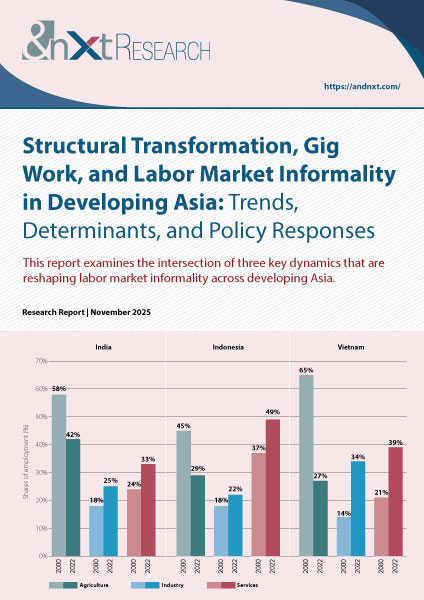
Report Abstract:
The informal sector in developing Asia is undergoing a structural metamorphosis. For decades, informality in the region was overwhelmingly agricultural — smallholder farmers, landless laborers, and rural household enterprises operating outside the reach of formal regulation, taxation, and social protection. This characterization remains accurate for the lowest-income economies of the Asia-Pacific, where agriculture continues to absorb the majority of informal workers. But across the middle-income economies that constitute the demographic and economic center of gravity of the region — India, Indonesia, the Philippines, Vietnam, Thailand — the composition of informality is shifting decisively toward services, and within services, toward a rapidly growing category that defies traditional analytical frameworks: platform-mediated gig work.
The central argument of the report is that the gig economy represents both the newest frontier of informality in developing Asia and the most analytically challenging. Gig workers share key characteristics with traditional informal workers — they lack written contracts, social protection coverage, and employment security. But they differ in important respects: they are typically more educated, more urban, more digitally connected, and more productive per hour than traditional informal workers. They operate through sophisticated digital platforms that mediate their work through algorithms, yet they are classified as independent contractors without the protections that their economic dependence on these platforms would warrant. They are simultaneously more visible to the state (because platform transactions generate digital records) and less protected by it (because labor law has not caught up with their employment reality).
Table of Contents:
Executive Summary
Chapter 1: Introduction — The Changing Face of Informality in Asia
Chapter 2: Structural Transformation and Informality — The Classical Framework and Its Limitations
2.1 The Lewis Model and Its Descendants
2.2 Structural Transformation in Developing Asia: The Empirical Record
2.3 Why Structural Transformation Has Not Delivered Formalization
Chapter 3: The Rise of the Gig Economy in Asia-Pacific — Scale, Scope, and Characteristics
3.1 Defining Gig Work
3.2 Scale of the Gig Economy in Developing Asia
3.3 Who Are the Gig Workers?
3.4 Gig Work as a Response to the Formalization Failure
4.1 A Comparative Framework
4.2 The Measurement Challenge
4.3 The Informality Continuum
Chapter 5: Determinants of Informality in the Age of Platform Work
5.1 Structural Determinants: What Has Not Changed
5.2 The Platform-Specific Determinants
5.3 The Interaction: How Structural and Platform-Specific Determinants Compound
5.5 Digital Infrastructure as a Determinant
Chapter 5A: Gig Work and the COVID-19 Pandemic — Accelerator and Stress Test
5A.1 The Pandemic Acceleration
5A.2 The Social Protection Failure
5A.3 Post-Pandemic Implications
6.1 Productivity Comparisons: Conceptual Challenges
6.2 Sources of Gig Worker Productivity Advantage
6.3 Productivity Constraints Specific to Gig Work
Chapter 7: Inclusive Development Implications — Social Protection, Gender, and the Gig Economy
7.1 The Social Protection Gap
7.2 The Gender Dimension
7.3 The Fiscal Dimension
Chapter 8: Policy Responses Across Asia-Pacific — What’s Working and What’s Not
8.1 India: The Code on Social Security 2020 24
8.2 Indonesia: Platform Regulation in a Fragmented Institutional Landscape
8.3 Republic of Korea: Gig Work in a Formal Economy Context
8.4 Thailand and the Philippines: Emerging Frameworks
8.5 Lessons Across the Region
8.7 Vietnam: Platform Growth in a Rapidly Formalizing Economy
8.8 Bangladesh: Gig Economy at the Frontier of Informality
9.1 Key Findings
9.2 A Differentiated Policy Framework
9.3 Cross-Cutting Recommendations
9.4 The Role of Regional Institutions
9.5 Looking Forward
References