
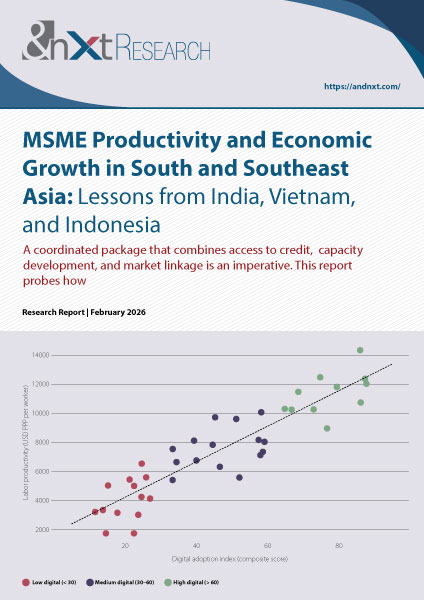
Research Abstract:
Micro, small, and medium enterprises (MSMEs) are the backbone of economic activity across South and Southeast Asia. In India, MSMEs account for approximately 30% of GDP, 45% of manufacturing output, and more than 110 million jobs. In Indonesia, they contribute approximately 61% of GDP and employ more than 97% of the workforce. In Vietnam, they generate approximately 40% of GDP and employ more than 50% of the formal labor force. Yet despite their aggregate economic significance, the productivity of individual MSMEs — measured as output per worker or value added per enterprise — is a fraction of that achieved by larger firms. This MSME productivity gap is one of the most consequential structural features of developing Asian economies: it depresses aggregate national productivity, limits the capacity of MSMEs to generate decent employment, constrains fiscal revenue, and perpetuates the informality that characterizes the majority of the MSME sector.
This report examines MSME productivity across three of developing Asia’s largest and most dynamic economies — India, Vietnam, and Indonesia — each of which illustrates a distinct dimension of the MSME productivity challenge. India’s MSME sector is the largest in absolute terms and the most structurally complex, spanning a continuum from street-level micro-vendors to sophisticated small manufacturers integrated into global supply chains. Vietnam’s MSME sector is undergoing rapid transformation, driven by export-led industrialization and foreign direct investment that is creating new opportunities — and new pressures — for domestic small enterprises. Indonesia’s MSME sector is the most digitally active, with platform-enabled micro-entrepreneurs representing a rapidly growing segment that is reshaping the relationship between enterprise size, productivity, and formality.
Table of Contents:
MSME Productivity and Economic Growth in South and Southeast Asia: Lessons from India, Vietnam, and Indonesia
Executive Summary
Chapter 1: Introduction — Why MSME Productivity Matters for Developing Asia
Chapter 2: The MSME Landscape — Scale, Structure, and Informality
2.1 Definitions and Data
2.2 The Dominance of Micro-Enterprises
2.3 Informality and the MSME Sector
Chapter 3: Measuring MSME Productivity — Approaches and Evidence
3.1 Labor Productivity by Enterprise Size
3.2 Total Factor Productivity and the Efficiency Gap
3.3 The Formality Premium
4.1 The Scale of India’s MSME Challenge
4.2 Structural Anatomy of India’s MSME Productivity Gap
4.3 India’s Policy Response: From MSMED Act to Udyam
Chapter 5: Vietnam — Export-Led Upgrading and the MSME Productivity Gap
5.1 Vietnam’s Dual Economy Challenge
5.2 The Spillover Question
5.3 Vietnam’s MSME Support Framework
Chapter 6: Indonesia — Platform-Enabled MSMEs and the Digital Productivity Dividend
6.1 Indonesia’s MSME Ecosystem
6.2 The Digital MSME Revolution
6.3 Constraints on Digital MSME Productivity
7.1 Access to Finance: The Binding Constraint
7.2 Human Capital and Managerial Capability
7.3 Technology and Digital Adoption
7.4 Regulatory Environment and Institutional Quality
7.5 Infrastructure and Connectivity
7.6 Supply Chain Integration and Market Linkages
Chapter 8: Policy Responses and Their Effectiveness
8.1 A Comparative Policy Inventory
8.2 What Works: Evidence from Evaluations
8.3 What Doesn’t Work: Common Policy Failures
8.4 The Gender Dimension of MSME Productivity
Chapter 9: Conclusions and Recommendations
9.1 Key Findings
9.2 Policy Recommendations
9.3 The Integration Imperative
References
Executive Summary